
You don’t want a sauna in the summer and a freezer in the winter.
But that’s what it’s like in the office at the far end of your house.
Thankfully, achieving tailored climate control for these rooms in your house is a reality thanks to mini split systems.
These ductless heating and cooling solutions offer comfort and remarkable efficiency improvements in your rooms that need it most. This is especially true in homes where traditional HVAC systems fall short.
Here are 4 reasons homeowners use mini splits (and why you should too!)
What you’ll find in this guide:
Ductless Design Flexibility
Mini splits stand out in the HVAC landscape primarily because they do not require ductwork.
Not installing ductwork avoids the mess and hard work of cutting through ceilings and walls.
This key feature makes them exceptionally suitable for:
- older homes where the architecture or historical preservation constraints make installing extensive ductwork impractical
- new additions such as sunrooms
- garages converted into living spaces
- expanded kitchen areas
Placement

These systems consist of:
- one outdoor unit mounted or placed near the exterior of your room
- small pipes in a conduit routed to your indoor unit(s) via a three-inch hole in the wall
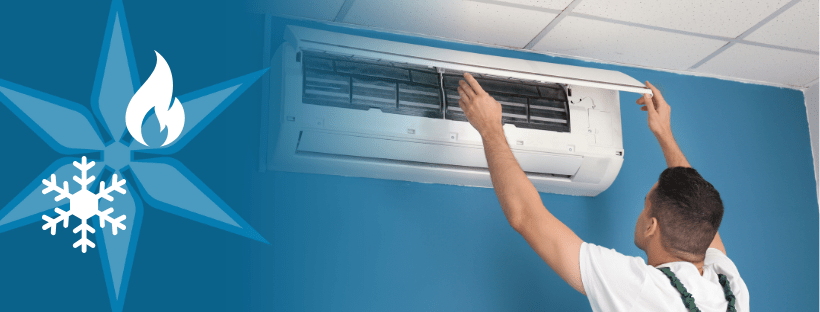
- indoor unit(s) mounted flush to the wall inside of your room
This minimal intrusion means you can install mini splits virtually anywhere in your home.
Whether it’s a top-floor bedroom that the existing central air system fails to cool adequately, a basement that needs consistent heating, or even multiple rooms, mini splits can help!
Energy Efficiency
Mini split systems are efficient because they have high SEER (Seasonal Energy Efficiency Ratio) ratings. The ratings often beat those of traditional HVAC units.
SEER ratings measure cooling output during a typical season. Then, it’s divided by the total electric input during the same period.
A higher SEER rating means more efficiency. This leads to lower electricity use and, thus, lower bills for you.
Buying and installing mini splits costs $3,000 to $8,000 for each unit. But, the savings from running them quickly balance the scales.
No Ductwork
Mini split systems directly cool or heat the rooms they’re attached to without ductwork. Ductwork has inefficiencies like leaks and thermal transfer.
The U.S. Department of Energy highlights that duct losses, through leaks or even just the natural thermal transfer of duct materials, can account for more than 30% of energy consumption, especially when the ducts are located in unconditioned spaces such as attics or crawl spaces.
Inverter Compressors
The modern design and technology in mini split systems often include features such as inverter compressors. They adjust their speed to maintain consistent temperatures without the energy-intensive on-and-off cycling common in traditional units.
This ensures greater energy efficiency and contributes to the system’s longevity, reducing maintenance and replacement costs over time.
Targeted Comfort Control
Cool the areas that need it most.
Individual thermostats for each indoor mini split unit allow you to choose the ideal temperature for you in each room.
This customization level ensures that your rooms with mini splits can be tailored to fit your comfort needs without overcompensating with your main HVAC system.
Easy Installation
Unlike traditional HVAC systems, mini splits can be set up with minimal disruption.
Installing a mini split system is simple and fast. It’s usually done in a single day.
The process involves:
- mounting the indoor unit(s) on an exterior wall
- mounting the outdoor compressor unit on an exterior wall or placing it on the ground
- connecting the indoor unit(s) to the outdoor compressor via small conduit(s)
- these conduits, which house the power cable, refrigerant tubing, and a condensate drain, require only a three-inch hole through the wall
Kauffman Gas is Here to Install Your Mini Split
Mini splits offer a great solution to improve your home’s heating and cooling efficiency.
Their flexibility, efficiency, and ease of installation make them attractive for those looking to extend comfort to new additions.
Tell us about the room in your house where your ducted HVAC system isn’t reaching. We’ll show you how a mini split system can make your home more comfortable and energy efficient.
Our experts are here to guide you through every step, ensuring your home and all of its rooms stay comfortable no matter the season.
Contact us today!
FAQs
Why do people use mini splits?
People opt for mini splits primarily due to their flexibility and efficiency. These systems require no ductwork, making them ideal for controlling temperatures in individual or multiple rooms. This results in personalized comfort and reduced energy usage, enhancing overall home efficiency.
Do mini splits devalue a house?
Mini splits do not typically devalue a house. Instead, they can increase property value by providing an efficient, modern heating and cooling solution. They are especially attractive in older homes or additions where traditional ductwork is impractical or impossible.
What is the disadvantage of a mini split?
The main disadvantage of mini splits is their higher initial installation costs compared to some traditional systems. Additionally, the visibility of the indoor units may not appeal to everyone, potentially affecting the aesthetics of room interiors.
What are the benefits of a mini split pump?
Mini split pumps offer significant benefits, including dual-function heating and cooling, making them versatile for year-round climate control. They are energy-efficient, support zoned temperature control, and operate quietly. These features contribute to improved home comfort and lower energy bills.