
Your spouse has to keep the house a constant, rigid 73 F° all year round—you’ve learned this a couple of times.
But can they really scold you if you change it on your phone?
Blame it on your new smart thermostat.
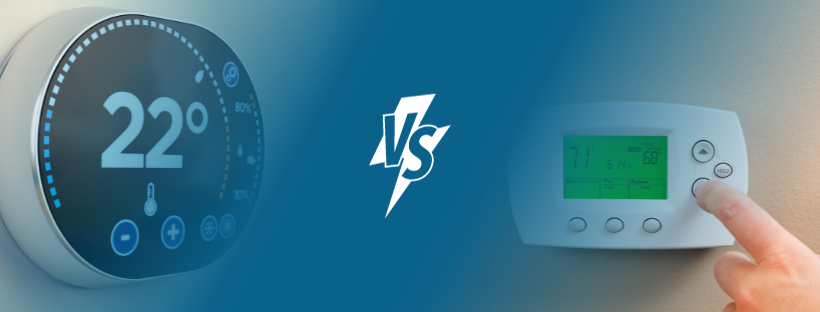
You have a choice between smart and programmable thermostats.
Which one is right for you?
Smart Thermostats
Smart thermostats can connect to your internet to enable remote control capabilities. If you want to change the temperature to keep your cats cozy while on vacation, you can do that!
These thermostats are equipped with learning algorithms and adaptive temperature settings that generally update your preferences within a few days to ensure you are comfortable at all hours of the day—without pushing a button.
Smart thermostats can be integrated with your existing smart home systems and voice assistants for seamless communication between your devices.
When you combine all of these features, smart thermostats are energy-efficient and convenient.

Programmable Thermostats
Programmable thermostats operate on pre-set temperature schedules for different times of day.
If you like it colder when you sleep, have your programmable thermostat set to be at a lower temperature through the night.
However, programmable thermostats don’t have the remote control features and learning capabilities that the smart thermostats do.
Programmable thermostats are still cost-effective and offer an element of simplicity if you’re only looking to change the temperature while you’re home. And they make it harder for your spouse to adjust the temperature whenever they want.
Similarities Between Smart and Programmable Thermostats
Both thermostats can adjust the temperature to save energy during unoccupied periods—like when you’re at work or the kids are at school.
There can be a potential reduction in your utility bills because of this feature.
Essentially, a smart thermostat is programmable, but it isn’t the other way around. Both can be set to be warm in the mornings or cold in the evenings or any way you like.
These thermostats can be considered environmentally sustainable if you aren’t using as much energy because of them.
With both devices, you have precise, programmable comfort at your fingertips.
Considerations for Homeowners in Choosing Between Thermostat Types
Energy-saving potential
Both thermostats are good at reducing energy consumption and costs.
However, smart thermostats will likely be more efficient because of their learning capabilities.
If you go on vacation, it’ll know, whereas with a programmable thermostat, you’ll have to set it to a specific temperature right before you leave.
And if you forget to change your smart thermostat before you go, your app can adjust the temperature for you remotely.
Lifestyle and Convenience
Smart thermostats adapt to your schedules and preferences, like when you aren’t home because you stay late at work on Wednesdays or when you like to sleep in on the weekends with the AC blasting.
You also get the convenience of remote control and integration with smart devices when you install a smart thermostat.
Budget
Programmable thermostats cost around $20–$150, while smart thermostats cost around $100–$300.
Both will save you around the same on energy.
Technical Proficiency
As might be expected, a smart thermostat will require a little more technical skill to set up and use than a programmable thermostat.
Compatibility with Existing Systems
Smart thermostats are compatible with most HVAC systems, but it may be best to stick with a programmable thermostat if you have an oil system or one installed before 1975.
We Can Help You Make an Informed Decision
Ultimately, you need the thermostat that best fits your priorities and needs. You can research different models and brands to help you make this critical decision.
Or, let us give you a hand. Kauffman Gas is experienced in propane HVAC services, so we can guide you to the right choice that’ll be best for you in the long run.
Don’t settle for less. Contact Kauffman Gas today so you can enjoy your new thermostat.
FAQS
What’s the difference between a smart thermostat and a programmable thermostat?
A programmable thermostat operates on preset temperature schedules for different times of day, like waking up or sleeping.
A smart thermostat, on the other hand, includes these scheduling capabilities plus advanced features like remote control via smartphone, learning your routines, adaptive adjustments, and integration with smart home systems.
Do smart thermostats save more energy than programmable ones?
Yes. While both types help cut costs by reducing heating or cooling when you’re away, smart thermostats often save more energy thanks to self-learning algorithms, geofencing, and remote control.
That extra layer of intelligence means they can make efficiency adjustments without manual input.
Which is more cost-effective: programmable or smart thermostats?
Programmable thermostats are generally cheaper (around $20–$150), offering basic scheduling benefits.
Smart thermostats cost more (about $100–$300) but bring remote access, adaptive learning, and smart home integration. Despite the higher upfront cost, their convenience and energy-saving features may offer better long-term value.