
What You’ll Learn
What should I expect during a new propane tank installation?
When installing a new propane tank, you should expect an on-site property evaluation, careful excavation, tank placement, underground gas line trenching, and system pressure testing.
A reputable provider gives you the cost upfront, protects your property from damage, and ensures uninterrupted heat—even setting up a temporary above-ground tank during freezing winter conditions so you never have to wait until spring to switch.
In this blog:
Joey had officially had enough of his propane provider.
The service had hit rock bottom with missed delivery windows, unreturned phone calls, and mystery fees showing up on his monthly statements.
Joey knew it was time to switch, but a new provider meant a whole new tank.
Knowing the horror stories about torn-up lawns and surprise installation fees, he hesitated.
At Kauffman Gas, we would never leave Joey out in the cold.
Switching suppliers shouldn’t feel like a gamble, and nobody wants to trade one bad provider for a torn-up front lawn. While digging is an unavoidable part of burying a new tank, our team takes careful steps to minimize disruption and protect your property every step of the way.
The Frustration of Unreliable Service
When you rely on propane to heat your home, cook meals, and warm your water, your fuel provider becomes a critical partner in keeping your household safe.
Too many Pennsylvania homeowners find themselves in this situation: They sign up with a supplier based on an attractive introductory fuel rate, only to watch customer service deteriorate over time.
Deliveries arrive late, emergency lines go straight to voicemail, and the monthly bills keep creeping higher.
When customers finally decide to make a change, the fear of the installation process and termination fees holds them back. They worry about backhoes destroying their landscaping, weeks of waiting for permits, and hidden setup charges.

Common Surprise Costs from Other Providers
Not all propane installation quotes are created equal.
Some companies offer low initial estimates to win your business, only to bill you for essential steps after the work is already underway:
- Permitting markups: Adding steep administrative surcharges on top of the actual local township permit fees.
- Trenching add-ons: Quoting only the cost to set the tank on the ground, then billing hefty per-foot fees once the crew begins trenching the gas line to the house.
- First-delivery and compliance fees: Tacking on unexpected hazardous materials fees, fuel recovery charges, or off-route delivery fees on your very first fill.
These surprise line items can quickly turn an affordable project into an expensive headache.
A dependable provider provides a clear, comprehensive quote before a single shovel touches your yard.
The Underground Tank Installation Process
Step 1: Site Evaluation and Zoning Clearance
Every successful installation starts with a thorough property survey.
A qualified technician visits your property in person to plan the tank’s location, taking your preferences and legal safety requirements into account.
Under National Fire Protection Association standards (NFPA 58), propane tanks must adhere to strict setback distances. For underground installations, both 500-gallon and 1,000-gallon tanks need to sit at least 10 feet away from any building foundation, property lines, and external ignition sources like air conditioning condensers.
If you choose an above-ground setup instead, that 10-foot rule still applies to a 500-gallon unit, but expands to a 25-foot perimeter for a 1,000-gallon tank.
During this stage, our team contacts Pennsylvania One Call (811) to locate and mark all underground utility lines, water pipes, and electrical conduits.
We also map out the best access route across your lawn to ensure heavy delivery trucks and excavation equipment do not disturb mature trees or damage driveways.
Step 2: Excavation and Tank Placement
Once permits are approved and underground lines are clearly flagged, the installation crew prepares the site for either an above-ground or underground tank.
For above-ground tanks, technicians place a solid, pre-formed concrete or composite pad.
This base keeps the tank completely level, protects it from ground moisture, and prevents the unit from shifting or sinking during spring thaws.
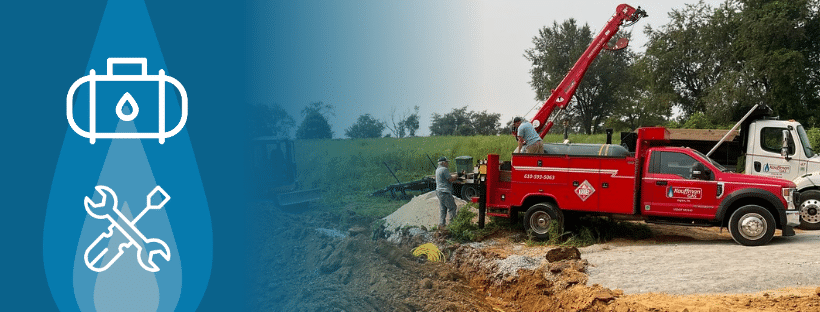
Underground installations require careful, controlled excavation.
Specialized digging equipment carves out a trench tailored to the tank’s dimensions:
- A standard 500-gallon underground tank requires an excavation roughly 11 feet long, 4 feet wide, and 5 feet deep.
- The hole is lined with smooth, stone-free soil or sand to cushion the tank shell.
- After lowering the tank into place, the crew backfills the area, leaving only a discreet green composite access dome exposed at ground level.
Step 3: Gas Line Trenching and System Pressure Testing
With the tank secured, the crew trenches a continuous line from the tank shutoff valve directly to your home’s foundation.
Technicians lay approved high-density polyethylene gas pipes underground below the winter frost line. Once the line reaches the house, it transitions to heavy-wall copper or steel, connecting to a dedicated second-stage regulator mounted to the exterior wall.
The final and most important phase is the safety check.
Technicians never simply turn on the gas and walk away.
Before introducing fuel into the house, our team performs a mandatory high-pressure leak test across the entire gas line and interior manifold.
We check every connection point, verify operating pressures at your furnace, water heater, and range, and light every pilot to ensure complete system safety.
The Kauffman Gas Transparent Installation Process
At Kauffman Gas, we believe that customer trust is earned through transparency.
We have served Chester, Lancaster, and Delaware counties for four generations by treating our neighbors with honesty and respect.
When you partner with Kauffman Gas, our in-house crews manage your installation from start to finish. We don’t hand your yard over to third-party subcontractors who rush through the job.
Our technicians treat your property with care, clean up thoroughly after excavation, and walk you through your new tank’s gauge, shutoff valves, and safety features before leaving.
You receive clear communication at every step, with zero hidden administrative fees or unannounced add-ons.
Make the Switch with Kauffman Gas
Sign up for dependable heating and completely transparent pricing.
Kauffman Gas makes switching simple with our $499 Propane Tank Installation and Hook-Up promotion for qualifying new residential delivery customers.
We manage your site survey, tank placement, line trenching, and safety testing with zero surprise fees.
Contact Kauffman Gas today to schedule your on-site evaluation and lock in your installation!
FAQs
How long does a typical propane tank installation take?
Most residential tank installations are completed in a single day.
A standard above-ground setup usually takes three to four hours, while an underground installation with excavation and line trenching typically requires four to six hours.
Will installing an underground propane tank ruin my landscaping?
Our certified crews use compact, turf-friendly excavation equipment designed to minimize ground disturbance.
We carefully separate topsoil, backfill the trench cleanly, and smooth out the work area so your lawn can be reseeded quickly.
Can I switch to Kauffman Gas if another company owns my existing tank?
Yes. Switching is a straightforward process.
Kauffman Gas will install and hook up your new tank first, ensuring your home never loses heat or hot water.
Once your new system is operating, your previous provider will simply schedule a pickup for their empty tank.
What safety inspections occur during a new tank installation?
Technicians conduct a complete NFPA-compliant pressure check and gas leak test on both the newly buried line and your home’s interior gas manifold.
Gas will not be turned on until every appliance connection and regulator passes strict pressure-holding standards.