
What You’ll Learn
What are the various propane tank options that I can choose for my home?
There are many propane tank options available, varying in shape, size, and whether you prefer to lease or purchase.
The best way to determine what works for your home is to nail down whether you want to lease or buy, and then discuss your options with your supplier.
In this blog:
This blog was updated February 2026.
Your neighbor just had a horizontal propane tank installed.
It looks clean and low-profile.
You want a nice propane tank too.
Propane tanks come in all shapes and sizes. If you’re ready to install a propane tank for your home, you need to find out what type of propane tank is right for your home.
We’ll walk you through the different sizes as measured by pounds and gallons, and explain what you can do with a residential propane tank.
Propane Tank Shape
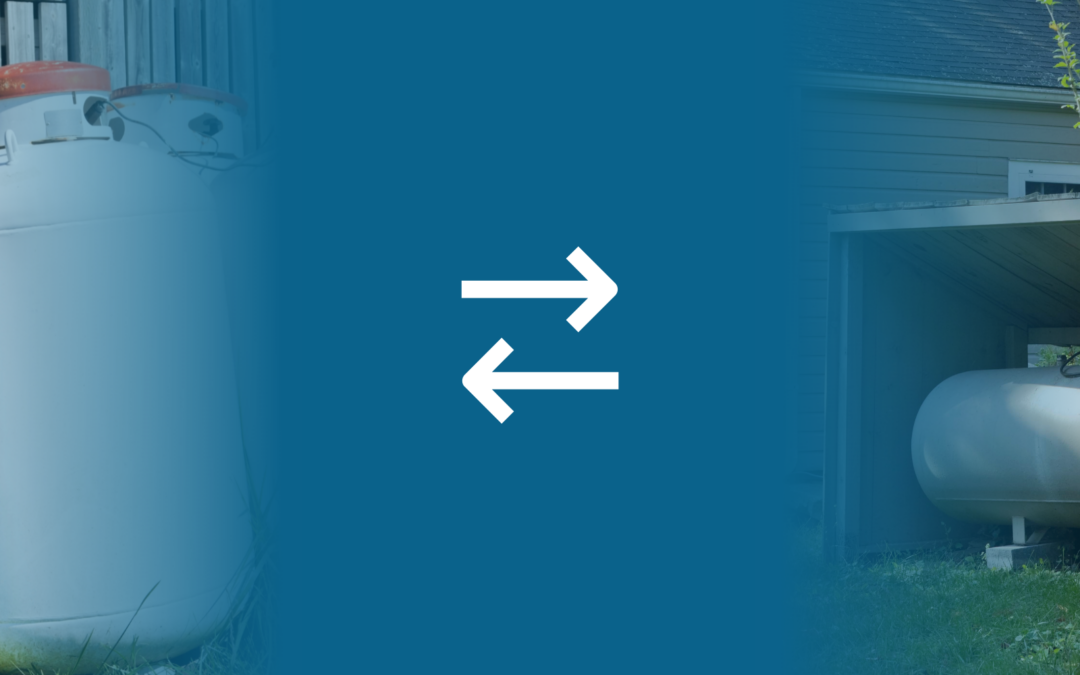
Propane tanks that remain above ground come in two types: vertical cylinders and horizontal tanks.
- Horizontal tanks (also known as torpedo tanks because of their unique appearance) are used when propane is the main source of a home’s heat. Since they’re so large, you won’t need deliveries as often. They’re ideal in remote areas with unpredictable weather patterns or harsh winters.
- Vertical cylinders are smaller. They’re easily placed against a home where they’re out of sight.
Common Propane Tank Sizes
The tank of your propane tank ranges from 20-lb portable cylinder tanks to 1,000+ gallon tanks, although most residential homes won’t need anything larger than this.
20-Pound Tank
A 20-lb tank is roughly 18″ tall and 12″ across. It can hold 5 gallons of propane, it’s portable, and it’s easy to carry. These are best for propane grills.
100-Pound Tank
A 100-lb tank is double the height of a 33-lb tank, coming in at 4 feet tall and 18 inches across.
This size tank holds roughly 25 gallons of propane and, although it’s portable, it is difficult for one person to move on their own.
These tanks are best for mixed heating systems or for homes that use less propane.
They’re also ideal for fireplaces and outdoor grills.

Remember: these tanks don’t include a gauge notifying you when it’s empty.
The recommended setup is to connect two of these tanks with an automatic change-over regulator that goes from green to red when the tank has no fuel left in it.
120-Gallon Tank
Similar to a 100-lb tank, the 120-lb tank is great for fueling stoves, dryers, space heaters, water heaters, fireplaces, and generators.
It isn’t designed for whole-house heating, however.
420-Pound Tank
A 420-pound tank isn’t portable. These tanks are four feet tall and 3 feet across and can hold 100 gallons of propane.
A fuel delivery company needs to refill this size tank at your home.
500-Gallon Tank
A 500-gallon tank is about 5 feet across and 10 feet long. These tanks hold about 400 gallons of propane when at 80% capacity, which is a standard fill size.
A 325-gallon tank is in a similar size category and is designed for homes that require 100-200 gallons of propane usage a month. However, 500-gallon tanks are ideal for homes that are 2,500 to 4,500 square feet.
These tanks are refilled at your home and can be either above-ground or underground.
1,000-Gallon Tank
A 1,000-gallon tank is about 5 feet tall and 16 feet long. They can hold 800 gallons of propane at 80% capacity, which is their standard fill size.
They’re above or below ground, depending on preference, and refilled at your home.
Decide Whether You Want To Lease Or Buy Your Tank
Now that you understand the different propane tank options, you need to decide if you should lease or buy your tank.
When you own your tank, you’re in control.
It’s recommended that you purchase your tank, as the benefits outweigh the drawbacks.
For example, you’re responsible for the installation and maintenance of your tank. Maintenance includes repairing or replacing parts.
You also need to have your tank recertified periodically in accordance with local and state laws. You’re also responsible for any fees associated with a supplier who doesn’t install and maintain your tank.
You can purchase a tank that’s new or used and works best for your budget. You might have to pay a one-time fee, but you won’t have to worry about monthly leasing costs.
Leasing your tank also has its benefits and its drawbacks.
Leasing ensures the supplier is responsible for installing and maintaining your tank. They also handle licensing and any other requirements, but you have limited ownership and monthly payments.
Discuss Your Options With A Trusted Supplier
The type of propane tanks you invest in depends on what you need them for.
Smaller tanks are ideal for grills, fireplaces, and dryers, but larger tanks can heat your whole house.
It’s best to discuss your individual propane tank options with a trusted supplier.
We offer prompt propane delivery.
Become a Kauffman Gas customer today to discuss our pre-buy program so you can purchase propane at a fixed rate.
FAQs
What are the two main above-ground propane tank shapes?
The two main shapes are vertical cylinders and horizontal (often called “torpedo”) tanks.
Vertical cylinders are smaller and more discreet, while horizontal tanks are larger for primary home heating.
What is the “standard fill” capacity for a large tank?
Large tanks like 500-gallon and 1,000-gallon models are typically filled to only 80% of their total capacity.
This provides necessary space for propane to expand safely.
What is the main advantage of buying (owning) a tank?
The main advantage is control and no monthly lease payments.
You own the asset outright and are not locked into a long-term agreement with a single supplier.
What is the main advantage of leasing a tank?
The main advantage is that the supplier handles all installation, maintenance, recertification, and repairs.
You are not responsible for the upfront cost or ongoing upkeep of the tank itself.