
What You’ll Learn
Should I choose an aboveground or underground 500-gallon tank for my home?
Your propane tank location comes down to what matters most to you. If you want a more affordable, quicker installation and don’t mind the look, an aboveground tank is a great choice.
If you’d rather keep your yard looking clean and want a tank that’s better protected from temperature swings, an underground tank may be the better fit.
In this blog:
500-gallon propane tanks are suitable for homes of 1,500+ square feet. A 500-gallon propane tank can handle heating the whole home and several appliances.
But once you get up to the 500+ gallon size, you have a decision to make…
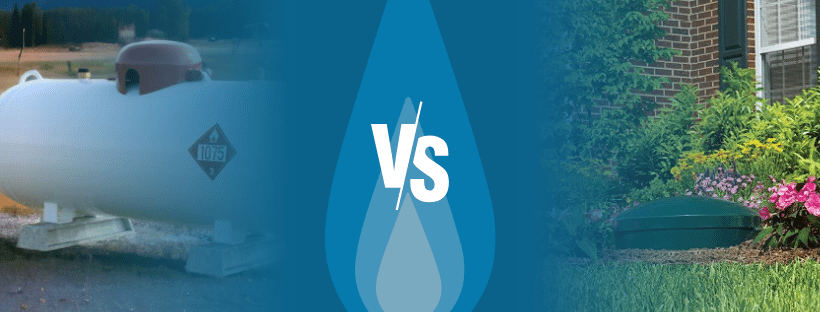
Do you want the propane tank installed aboveground or underground?
Both forms of installation have their pros and cons for your property. Let’s take a look at which option is best for you.
New Customer Special Offer: Lock In Your Propane Price Per Gallon for 12 Months
Have a better-looking yard with an underground 500-gallon propane tank
When deciding whether to install your 500-gallon propane tank aboveground or underground, consider how your yard is going to look.
Many people don’t like the look of the aboveground tank. It can be a bit of an eyesore. An aboveground tank can require some creative landscaping approaches to hide.
On the other hand, underground propane tank installations require you to dig a hole in your yard. The hole for a 500-gallon propane tank will measure 11 feet long by 4 feet wide and 5 feet deep.
In the short-term, excavating your yard will cause the most damage, leaving a large patch of dirt you’ll need to fill in. But in the long-term, you can plant grass seeds or sod, and eventually you’ll be able to plant and landscape. In which case, your yard may look even better than before. And keep in mind that sometimes underground propane gas tanks can raise the value of your property.
Read about the process for underground propane tank installation >>
Save on the cost of installation with an aboveground propane tank
An aboveground propane tank installation costs a good deal less than its buried counterpart, and it’s obviously a quicker process. Installing an aboveground tank is like dropping and dragging compared to the amount of work involved when installing an underground tank.
The underground tank requires professional propane gas providers to excavate your lawn, plant the tank on a firm foundation, and backhoe a smooth fill on top of the gas tank. There are also extra layers (sacrificial nodes) that need to be lined around the tank for long-term protection. These add-ons nearly double the cost of an aboveground tank.
But the cost won’t change after the installation. Regular refill and maintenance costs will be the same for both tanks once they’re ready for use.
Underground 500-gallon propane tanks handle extreme temperatures better
You might be wondering why someone would want to pay extra to put a propane tank underground. One reason is that underground tanks are surrounded by earth, and it’s much easier for these tanks to stay temperate in extreme weather, especially freezing cold. Obviously, aboveground tanks aren’t protected or contained by any barrier and are exposed to all weather conditions.
Underground propane tanks are also safer underground when it comes to potential damage like propane leaks, since a gas leak would be more contained by the soil. And that isn’t a problem since propane is harmless to your water and the environment.
Aboveground tanks handle flooding better
But, one concern you might have with underground tanks is “floating”. Floating means the tank could shift under the ground if it’s not settled on a sturdy foundation.
Most propane providers will position the underground tank properly so that it’s unlikely to move. However, if you’re in an area prone to flooding, an underground tank can float if the water rises above the propane level in your tank.
Because aboveground tanks are higher up, they are safer in flooding conditions. Aboveground tanks stand a few inches off the ground and are bolted down at the feet.
Choose the 500-gallon propane tank that works best for you
Both aboveground and underground propane tanks have their pros and cons; it really comes down to what’s right for your property and your personal preference. Whether you decide on an aboveground or underground propane tank, make sure you choose the right size for you.
If your property or propane usage is a bit larger, you may want to consider a 1,000-gallon tank before you make the purchase. If you decide on installing a 500-gallon underground tank, don’t miss out on Kauffman’s free installation.

FAQs
What size home is a 500-gallon propane tank best for?
A 500-gallon propane tank is typically best for homes over 1,500 square feet. You can use it to heat your home and power multiple appliances efficiently.
Are underground propane tanks safer than aboveground tanks?
Underground propane tanks can offer added protection from external damage and temperature fluctuations. However, both aboveground and underground tanks are safe when installed and maintained properly by a professional.
How much does it cost to install a 500-gallon propane tank?
You can expect an aboveground propane tank installation to cost significantly less than an underground installation. Underground tanks require excavation, additional materials, and labor, which can nearly double the installation cost.
Can an underground propane tank float or move?
Yes, in areas prone to flooding, an underground propane tank can shift if it is not installed on a secure foundation. You can prevent this by ensuring proper installation and working with an experienced propane provider.